Ramblings of someone on the internet

Octoprint all the things

Why you absolutely want to try this.
octoprint

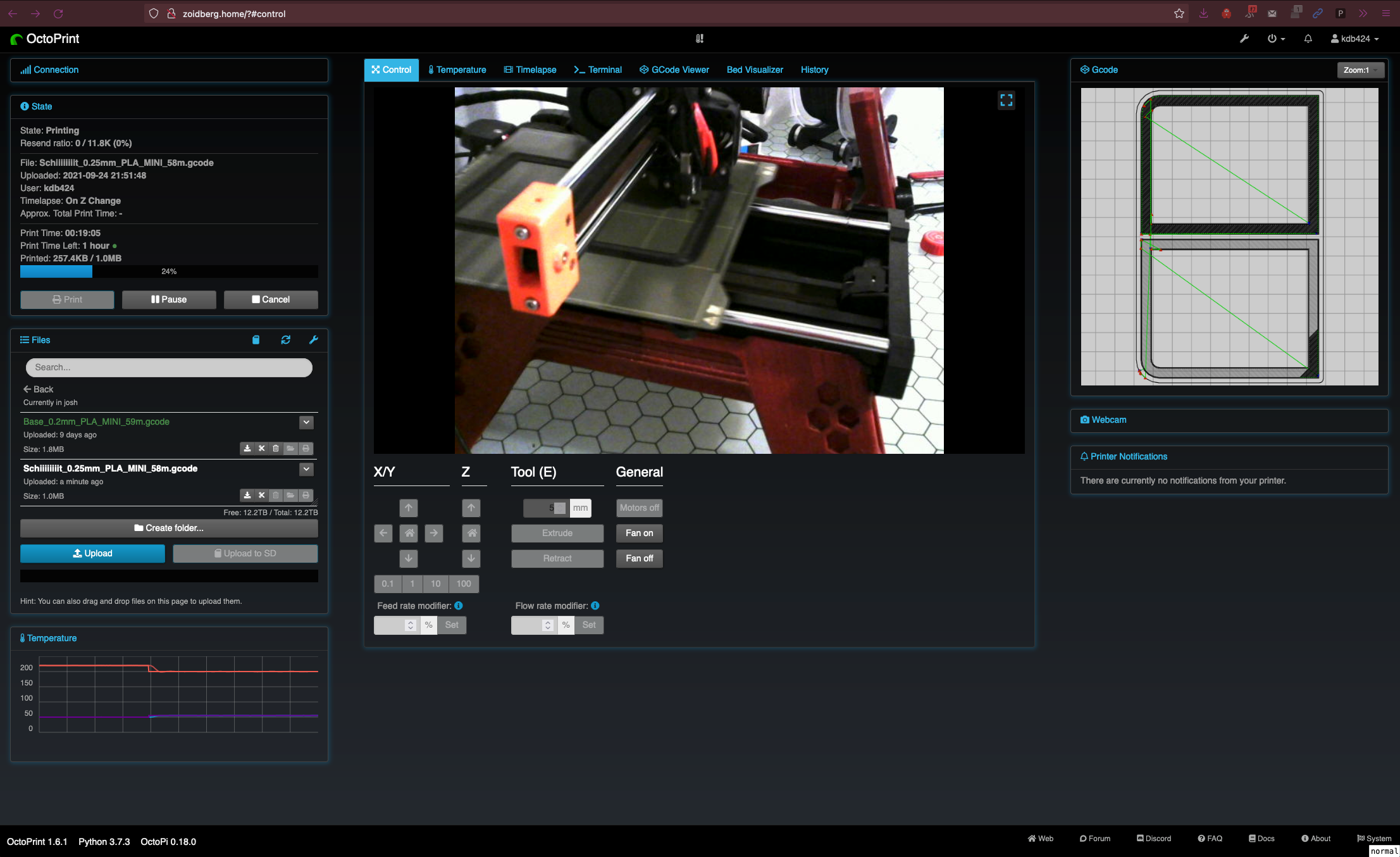
Octoprint is a simple concept. It's a web server that gives you control of your printer. This could be useful if you don't have a screen, but it can do a lot more than just print a gcode file. I'll touch on a few features of octoprint that make it compelling to many users.

Send a print directly from a slicer

Many modern slicers such as PrusaSlicer, SuperSlicer, Slic3r, ect all have the ability to communicate directly with octoprint. This saves the hastle of moving a flash drive around, and trying to remember what settings were in the gcode if you may be using a different filament than you were before. No need to wonder any more. Just slice, and send it over!

Instructions for PrusaSlicer and SuperSlicer can be found here

Read more  ↩︎

Prusa Mini: Initial thoughs

How good can it be for $400?

Short answer: Amazing. Buy one right now, then come back to read what you just got for your money.

The longer answer is probably why you are here, so I guess I should stop stalling. I've played with other's printers on and off for years. I hear other people that have 3D printers complaining that it's basically just another project car. Something you sink money and time into, and it gives you nothing but problems, but you enjoy it for the hobby. This is exactly what I didn't get with the Prusa Mini.

Read more  ↩︎

Zerotier. When opening ports isn't ok

Zerotier Primer

To understand this, you'll first need to understand the very basics of how ipv4 networks work. I'll only gloss over things here, but you won't need to know a lot in order to actually use zerotier. It's mearly explaining what you should understand in order to know how to use it.

Read more  ↩︎

What's all the fuss about docker?

Why is everyone excited?

Docker is, simply put, a container. How is this at all exciting? Think about any time you set up a system, and how long you spend setting it up. No matter if it's a web server, a build environment or any other system service. Do you want to do that all over again when you move systems? What about updating your operating system under it, and having to deal with config file changes, and the other cruft that gets left behind, and causes problems over time? Not having to deal with any of this is why people like docker.

Read more  ↩︎

ZFS. It's not a filesystem, it's an ecosystem

What is a filesystem?

All computers need to give you access to files. This seems quite obvious at first, but how those files get stored, most people don't seem to think about. Files need to be stored on a disk (or a network, but lets focus about on disk), and that disk needs a way to know where files are, how big they are, ect. This is all part of a filesystem. Some common ones that people may know about are

  • NTFS
  • FAT32
  • EXT4
  • HFS+
  • APFS

These are just a few examples that can be found on different operating systems, and you are bound to recognize at least one.

Read more  ↩︎

Why all the distros?

Why does distro even matter

Linux is insane vague in what it is, and just a pile of source code for the most part. It's up to people to put the pieces together, and choose what's included or not. There is no perfection in life for all use cases, or users. This leaves us with lots of different "distros", which are just sets of default applications that are installed for the most part. Some defaults are better for things like running a server, others are better for realtime audio workstations, others are better for new users of desktop systems and include everything but the kitchen sink.

Read more  ↩︎

Hosting (Aka, how this page gets to you)

How this page gets to you

TLDR: VPS --> zerotier --> docker swarm --> docker container

The long answer

Nginx

Opening ports is generally a security risk, so I wanted to be able to self host, without opening ports where possible. With a cheap VPS running nginx, I'm able to reverse proxy back to where my docker swarm is. That still requires opening ports one would think, but the magic of zerotier makes that not a problem. I'll talk about this later.

Read more  ↩︎

PMM (Package Manager Manager)

Motivation

PMM came about from a simple frustration. "Why is there so much cruft installed that I just don't care about in my system?!" This is pretty simple to solve one would think. Just list all packages with something like pacman -Qqe, go through them all one by one, and remove what you don't want. After doing this many times, I remembered that Gentoo had solved this in a much better way. A world file was the simple way to keep track of what you explicitly installed, and not worry about dependencies. It only tracked what you actually wanted. I went on the hunt to see if other package managers were able to keep track of things like orphans, dependencies, and explicitly installed packages, and it turns out that most modern package managers can.

Read more  ↩︎

Hello Blog!

Welcome to my blog where I'm sure I'll ramble about many things. This is all written in markdown, and uses pelican to create a static site, and generate all of these pages. Hopefully I can update everyone on whatever I'm working on as I have time to post.

I'm hoping to do a writeup on several projects that I've contributed to, or am working on. This may include a deep dive into pmm, KMK or whatever other 3 letter project I happen to contribute to.